When to Protect Your Home From Ant Invasions: A Seasonal Prevention Guide
Learn when to protect your home from ant invasions with a seasonal prevention guide covering entry points, food sources, moisture, and practical pest control tips.

At GlowyDecor, we spend most of our time talking about the beautiful parts of homekeeping: color palettes, styling hacks, and the small details that make a house feel finished. But every reader who has spent a season keeping a kitchen counter spotless or a pantry perfectly organized knows that pests have a way of undoing all that effort in an afternoon. A single trail of ants across a freshly styled countertop can undo weeks of careful decorating, which is why timing your pest prevention matters just as much as timing your seasonal decor refresh.
That connection between beautiful spaces and functional upkeep is exactly why we wanted to cover ant prevention through a seasonal lens rather than a generic checklist. If you live in a warmer climate region, the seasonal patterns are especially pronounced, and homeowners researching the ants in irvine ca homeowner guide quickly learn that Southern California's mild winters change the entire prevention calendar compared to colder states. Understanding when colonies are most vulnerable, and when they are most aggressive, gives you a real advantage over reacting after ants have already found their way indoors.
Spring Awakening: Early March-April Prevention Window
Ant colonies spend the coldest months in a semi-dormant state, but that changes fast once soil temperatures climb into the 50 to 60 degree range. Data from 2025 and 2026 pest activity tracking shows peak ant activity spanning March through October, with the spring emergence in March and April marking one of the two most critical windows of the year. As colonies wake up, worker ants begin scouting aggressively for food to rebuild depleted reserves after winter, which means bait stations and perimeter treatments placed now intercept the colony before it reaches full strength. Waiting until ants are visibly marching across your floors means you are treating a colony that has already multiplied several times over. Early spring is also when foundations, weep holes, and utility entry points should be sealed, since these gaps are the same ones ants will exploit for the rest of the year once they find them.
Summer Peak Activity: May-August Maintenance and Moisture Control
Summer is when colony populations reach their maximum size, and it is also when indoor invasions spike as ants search for water sources to cope with dry, hot conditions outside. This is less about applying new treatments and more about maintaining the barriers you set in spring while eliminating the moisture and food access that draws ants indoors in the first place. Leaky faucets, damp basements, uncovered pet food bowls, and crumbs left on counters overnight all become magnets during these months, and even a well-organized kitchen can attract a scout ant looking for a water source near a sink. Homeowners who already follow tidy storage habits, the kind covered in our own folder of organization tips, tend to have an easier time here because sealed containers and clutter-free counters remove most of the incentive for ants to stick around. It is worth noting that recent industry surveys found more than 80 percent of homeowners across Millennials, Gen X, and Baby Boomers rank ants and wasps as their top pest concern in and around the home, which shows this is a shared worry rather than an isolated complaint.
Fall Preparation: August-September Second Treatment Window
As summer winds down, colonies shift into a different mode entirely, intensifying foraging to store energy and protein before cooler weather arrives. This makes late August through September the second major treatment window of the year, and pest professionals consistently point to it as being nearly as important as the spring application. According to How to control household ants? | OSU Extension Service, early spring and late summer represent optimal treatment windows when carbohydrate demand peaks and baits work most effectively during brood-rearing phases, making preventive treatment significantly more effective and less expensive than chasing an established summer infestation. A 2023 NPMA survey backs this up on the professional side, finding that 58 percent of pest control providers report needing at least two treatments across a season to achieve effective control. Skipping the fall window often means dealing with satellite nests that formed indoors over the winter, only to reemerge stronger the following spring.
Winter and Year-Round Vigilance in Warmer Climates
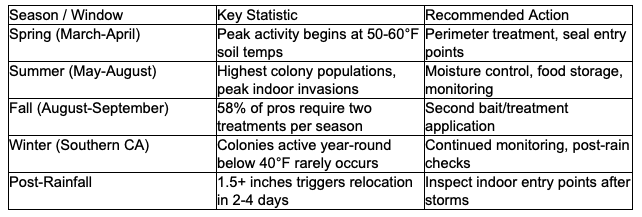
In regions with mild winters, ant prevention never really goes on pause. Argentine ant colonies, among the most common household invaders in Southern California, remain active essentially year-round because temperatures rarely fall below 40 degrees, which allows continuous breeding and foraging even in what would normally be considered the off-season elsewhere. Rainfall adds another layer of urgency here, since research shows that storms exceeding 1.5 inches can trigger entire colonies to relocate within two to four days, and in the case of heavy downpours, colonies can move indoors within hours as they escape flooded nests. That means winter rain events deserve the same vigilance homeowners apply during spring emergence, not a relaxed attitude just because temperatures have cooled. The table below summarizes the seasonal patterns worth building into your home maintenance calendar.
Protecting a home from ants is ultimately a matter of timing rather than luck. Homeowners who treat spring and late summer as their two anchor points, while staying alert during rainy stretches and mild winters, avoid the far more disruptive experience of an established indoor colony. Just as a well-planned decor refresh depends on knowing when to act, effective ant prevention depends on recognizing these seasonal cues before the problem becomes visible on your countertops.
Stay up to date with our latest ideas!